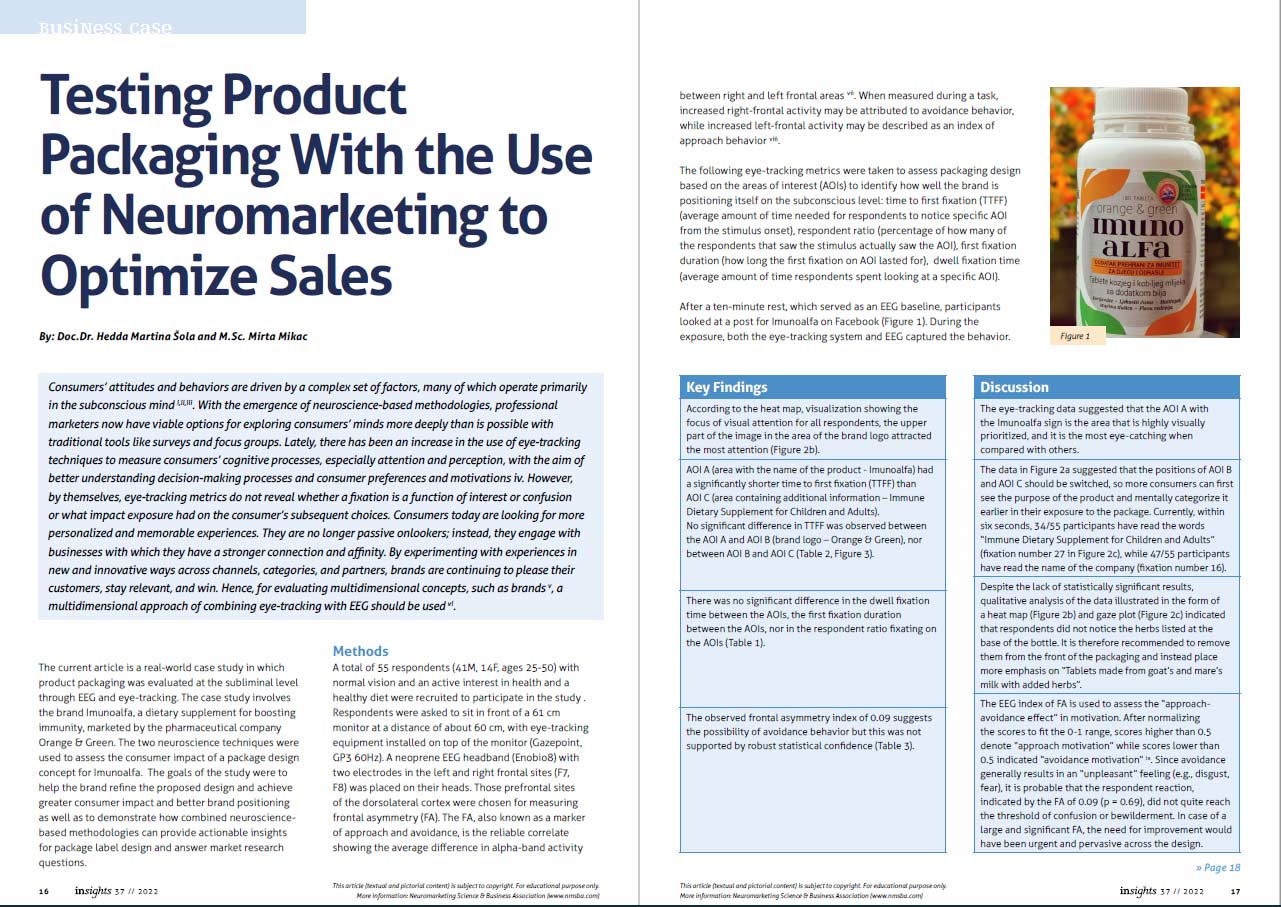
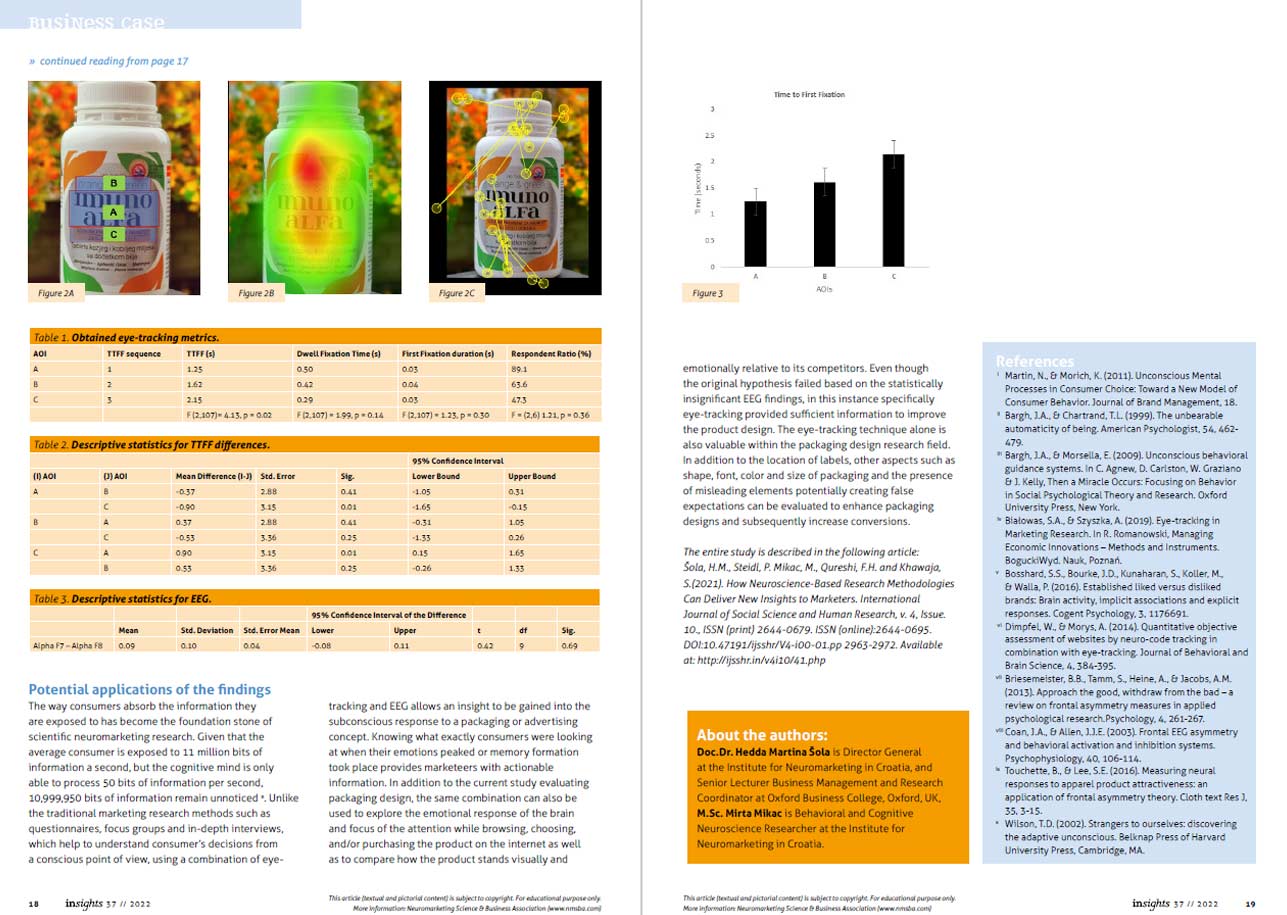
Consumers’ attitudes and behaviors are driven by a complex set of factors, many of which operate primarily in the subconscious mindi,ii,iii. With the emergence of neuroscience-based methodologies, professional marketers now have viable options for exploring consumers’ minds more deeply than is possible with traditional tools like surveys and focus groups. Lately, there has been an increase in the use of eye-tracking techniques to measure consumers’ cognitive processes, especially attention and perception, with the aim of better understanding decision-making processes and consumer preferences and motivationsiv. However, by themselves, eye-tracking metrics do not reveal whether a fixation is a function of interest or confusion or what impact exposure had on the consumer’s subsequent choices. Consumers today are looking for more personalized and memorable experiences. They are no longer passive onlookers; instead, they engage with businesses with which they have a stronger connection and affinity. By experimenting with experiences in new and innovative ways across channels, categories, and partners, brands are continuing to please their customers, stay relevant, and win. Hence, for evaluating multidimensional concepts, such as brandsv, a multidimensional approach of combining eye-tracking with EEG should be usedvi. The current article is a real-world case study in which product packaging was evaluated at the subliminal level through EEG and eye-tracking.The goals of the study were to help the brand refine the proposed design and achieve greater consumer impact and better brand positioning as well as to demonstrate how combined neurosciencebased methodologies can provide actionable insights for package label design and answer market research questions. (Šola, H.M. & Mikac, M. (2022). Testing Product Packaging With The Use of Neuromarketing to Optimize the Sales. Insights 37. Neuromarketing Science and Business Association, Netherlands. pp.16-19.)
The whole article you can download here.
References:
i Martin, N., & Morich, K. (2011). Unconscious Mental Processes in Consumer Choice: Toward a New Model of Consumer Behavior. Journal of Brand Management, 18.
ii Bargh, J.A., & Chartrand, T.L. (1999). The unbearable automaticity of being. American Psychologist, 54, 462-479.
iii Bargh, J.A., & Morsella, E. (2009). Unconscious behavioral guidance systems. In C. Agnew, D. Carlston, W. Graziano & J. Kelly, Then a Miracle Occurs: Focusing on Behavior in Social Psychological Theory and Research. Oxford University Press, New York.
iv Białowas, S.A., & Szyszka, A. (2019). Eye-tracking in Marketing Research. In R. Romanowski, Managing Economic Innovations – Methods and Instruments. BoguckiWyd. Nauk, Poznań.
v Bosshard, S.S., Bourke, J.D., Kunaharan, S., Koller, M., & Walla, P. (2016). Established liked versus disliked brands: Brain activity, implicit associations and explicit responses. Cogent Psychology, 3, 1176691.
vi Dimpfel, W., & Morys, A. (2014). Quantitative objective assessment of websites by neuro-code tracking in combination with eye-tracking. Journal of Behavioral and Brain Science, 4, 384-395.