LABELLING AI CONTENT AND COMPLIANCE WITH REGULATION (EU) 2024/1689
The obligations to label content created with artificial intelligence apply from 2 August 2026 and follow from the AI Act, Regulation (EU) 2024/1689. In June 2026 the European Commission also published the Code of Practice on Transparency of AI-Generated Content, which governs how visuals generated with artificial intelligence are to be labelled, and the Institute for Neuromarketing & Intellectual Property is a signatory to it.

Who the obligations apply to
The obligations apply not only to the makers of artificial intelligence tools, but to every company, institution and organisation that uses such tools in its regular work. The AI Act distinguishes two roles. The maker of the tool must mark the output in a machine-readable format so that it is detectable as artificially generated or manipulated (Article 50(2)). Whoever uses the tool and publishes the content must disclose that the content has been artificially generated or manipulated (Article 50(4)). The same obligation applies to text published to inform the public on matters of public interest, unless it has undergone human editorial review for which a person holds editorial responsibility.
One difference in the deadlines is worth noting. Under Regulation (EU) 2026/1744, makers of tools already on the market before 2 August 2026 have until 2 December 2026 to implement machine-readable marking. The obligation on whoever publishes the content is not deferred and applies from 2 August 2026. In other words, the fact that your tool is not yet compliant does not postpone your own obligation.
Visuals created or edited with artificial intelligence that depict real places, products or people and appear authentic fall within the scope of these obligations. The Act defines such content as artificially generated or manipulated material that resembles existing persons, objects, places or events and would falsely appear to a viewer to be authentic (Article 3(60)). This covers advertisements, social media posts, catalogues, brochures, websites, out-of-home advertising and all other promotional materials produced with generative tools.
The obligation attaches to publication, not to the tool. Responsibility rests with whoever publishes the material. The disclosure must be provided clearly and distinguishably, at the latest at the time of first exposure, and must meet the applicable accessibility requirements (Article 50(5)). The obligations apply from 2 August 2026 (Article 113), and administrative fines are prescribed for breaches (Article 99(4)(g)).
The method of labelling is governed by the European Commission’s Code of Practice on Transparency of AI-Generated Content, to which the Institute is a signatory.
What we offer
We offer our clients:
- a review of existing visuals and a determination of which of them fall within the scope of the obligations;
- the labelling procedure, meaning what is labelled, in what form and where on the design itself;
- instructions for designers and for the external agencies that produce your visuals;
- a method for recording how each visual was created, where the data is stored and for how long;
- provisions to be included in contracts with external collaborators;
- guidance on what to watch for at the design stage, so that material is compliant from the outset;
- a control neuromarketing measurement of how the label affects attention and the perceived credibility of the visual;
- ongoing supervision of implementation and advisory support throughout the year, with each new material reviewed before publication.
Why this is not only a compliance question
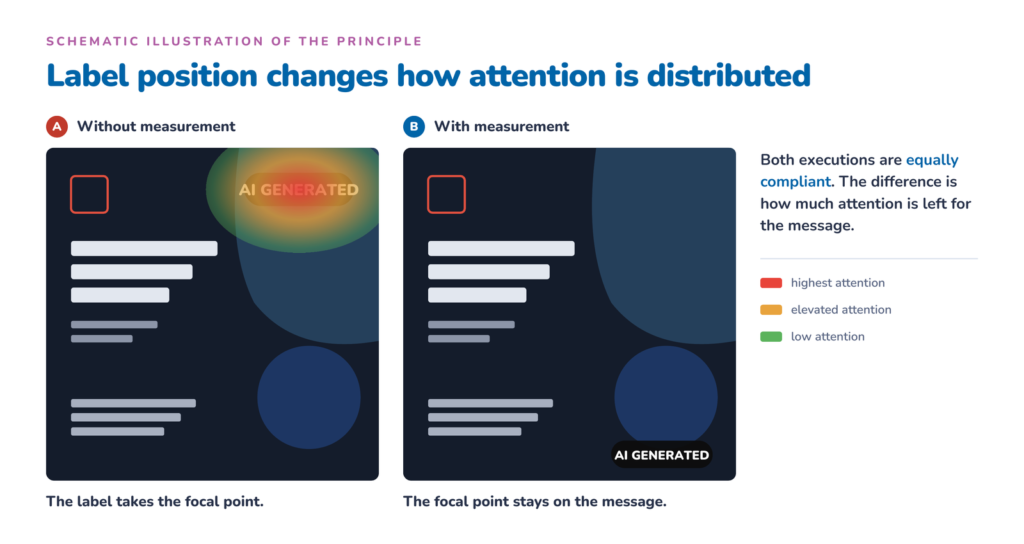
An AI label is not a sticker added to a finished visual. It becomes part of it. It comes in four variants, each designed to be noticed at first glance, which makes it a point of strong contrast on the surface of the visual. The eye finds such points on its own, before the viewer has decided where to look.
The consequence is not visible in the appearance of the visual but in the distribution of attention. Attention is finite and, within a single visual, always adds up to 100%, so every area that takes a share takes it from the others. When an AI label captures one of the first fixations, it does not take it from the background but from the carrier of the message, and in less than 2 seconds of viewing it is decided what will reach the viewer at all. What does not receive attention within that window does not remain in memory either, so the loss does not show on the material itself but later, in how many people recall the message.
There is a second effect, which runs against the very purpose of the rule and which is already documented in the literature. Peer-reviewed research shows that viewers judge content labelled as AI-generated to be less credible, regardless of whether the content is accurate and regardless of whether artificial intelligence actually produced it. In two pre-registered experiments with 4,976 participants in the United States and the United Kingdom, labelling lowered the perceived accuracy of the content and the willingness to share it, and the authors attribute this to the assumption that labelled content was produced fully automatically, without human oversight (Altay and Gilardi, 2024). The same pattern is confirmed in more recent work, where labelling reduces audience trust (Toff and Simon, 2025) and lowers the perceived credibility of accurate content (Lin and Zhang, 2026). In other words, the AI label was introduced to increase trust, and measurement shows that under certain conditions it reduces it.
The European Commission’s rule, however, governs labelling, not composition. The Commission itself states on its page on the EU icons that use of the icon does not by itself establish legal compliance, and that responsibility for meeting the obligations remains with whoever publishes the content. The label is therefore only one part of the process. Alongside it come the correct choice of variant, placement, size, legibility, the record of how each visual was created, and the record of the basis on which the label was applied.
Within what is permitted there is a range of possible executions, and the difference between them is not a matter of judgement but a measurable quantity, visible in the distribution of attention across the areas of the visual, in dwell time, in the probability of recall and in the rated credibility of the depiction. That is why, alongside compliance work, we carry out neuromarketing measurement to establish the execution of the AI label that satisfies the obligation while consuming the least attention intended for the message and least reducing perceived credibility. Compliance and effect are not opposed, but their relationship cannot be assumed. It can only be measured.
How we work together
Step one, review. We examine existing materials and determine which of them fall within the scope of the obligations. The result is a list of materials ranked by priority.
Step two, protocol. We draw up a labelling procedure tailored to your materials, together with instructions for designers and external collaborators.
Step three, neuromarketing measurement. We measure how the label affects attention and perceived credibility, and propose an execution that satisfies the obligation without loss of effect.
Step four, documentation. We compile a compliance file containing the list of reviewed materials, the adopted labelling procedure, the instructions issued to designers and external collaborators, the record of how each visual was created, and the measurement results. That file is your proof that measures were taken and when they were taken, because supervision asks not only for the label on the visual but also for the record of the basis on which it was placed.
Why the Institute
The Institute appears on the first list of signatories to the Code of Practice on Transparency of AI-generated Content, published by the European AI Office on 31 July 2026. Around 190 organisations have signed, among them Google, Meta, Microsoft, OpenAI, Anthropic, Mistral, Getty Images, Lenovo, Lufthansa, Bulgari, Iberdrola, the National Bank of Romania and the European Court of Auditors. The Institute is among the 152 signatories of Section 2, which covers the obligations of those who publish content, under Article 50(4) and (5) of Regulation (EU) 2024/1689.
That signature carries legal weight. On 8 July 2026 the European Commission concluded by opinion that the Code adequately covers those obligations, and the European Artificial Intelligence Board endorsed that assessment on 9 July 2026. The Code is therefore the recognised Union-wide instrument on which signatories may rely to demonstrate compliance, irrespective of their place of establishment and of the competent market surveillance authority.
From September the Institute takes part in the task forces established under the Code. Our contribution concerns the question that is also the subject of our own research: how an AI label is processed below the level of conscious attention, how much attention it takes from the carrier of the message, and where it is best placed so that it serves its purpose without cancelling the communicative effect of the material it sits on. This is not a theoretical question. Peer-reviewed research shows that content labelled as AI-generated is judged less credible, regardless of whether it is accurate and regardless of how much artificial intelligence was in fact involved. A rule introduced to build trust can spend it instead if the label is poorly placed. In line with the principle we apply across all our services, the methodology and metrics we measure with are publicly available in our published research. We approach compliance from the marketing and visual side, that is, at the point where the legal obligation meets the effect of the communication.
Deadlines and penalties
The labelling obligations apply from 2 August 2026, and enforcement rests with the national market surveillance authorities.
On 20 July 2026 the European Commission also published its Guidelines on transparency obligations, clarifying the scope of the concepts, the exceptions and their application in practice. The Guidelines are not binding, but national market surveillance authorities take them as their starting point when assessing compliance.
Article 99 of the AI Act prescribes administrative fines. A breach of the transparency obligations under Article 50 carries a fine of up to EUR 15,000,000 or up to 3% of total worldwide annual turnover in the preceding financial year, whichever is higher. Supplying incorrect, incomplete or misleading information to the competent authorities carries a fine of up to EUR 7,500,000 or up to 1% of total worldwide annual turnover. For small and medium-sized entities, including start-ups, the lower of the two amounts applies.
In supervision, the assessment turns on whether the organisation has taken reasonable measures and whether it can document them. Documented implementation therefore carries the same weight as the label itself, and a complete compliance process can be carried out within a short time.
If you would like us to carry out the full compliance process for you, tell us which services from the list you need and we will prepare an offer tailored to the scope of your materials.
Frequently asked questions
Does the obligation also apply to photographs that have only been edited with artificial intelligence?
It depends on what the editing changed. Routine processing, such as colour correction, exposure or cropping, does not change what the photograph recorded and does not create an obligation. The obligation arises when the editing changes the content of the depiction itself, for example when elements are added, removed or replaced while the result still reads as an authentic record of a real place, product or person. In practice the boundary is not always obvious, which is why we establish it by reviewing the existing materials.
Do materials created before 2 August 2026 need to be labelled?
They do not. For image, audio and video content the relevant date is the date of creation, so materials produced before that date are not subject to retroactive labelling, even when they remain in circulation. For text published to inform the public, the relevant date is the date of publication. This is precisely why keeping a record of how each visual was created matters, because without it you cannot prove when a given material was produced.
Is it enough to place the icon in a corner of the visual?
It is not. The Commission also prescribes how the label is displayed. It must be embedded in the content itself rather than only in the accompanying post text, it must remain visible when the image is reshared or downloaded, it must sit where no other element overlaps it, and it must appear in a clearly visible size. The text accompanying the icon must use plain language and avoid abbreviations other than “AI”, and alternative text for screen readers is recommended. This is where compliance most often fails, because a label that looks tidy on a desktop screen is cropped out of a social media preview.
Will the label spoil the appearance of the visual?
Most likely it will, if it is placed without verification. That is why we carry out neuromarketing measurement of the entire visual with all its elements, so that we can give you the optimal solution, one in which the communication retains its effect while the material meets the prescribed obligation.
Do you work with agencies as well?
Of course. For agencies we prepare the protocol and the instructions which they then apply in the work they do for their own clients.
Sources
Altay, S., & Gilardi, F. (2024). People are skeptical of headlines labeled as AI-generated, even if true or human-made, because they assume full AI automation. PNAS Nexus, 3(10), pgae403. https://doi.org/10.1093/pnasnexus/pgae403
Toff, B., & Simon, F. M. (2025). “Or they could just not use it?”: the dilemma of AI disclosure for audience trust in news. The International Journal of Press/Politics, 30(4), 881–903. https://doi.org/10.1177/19401612241308697
Lin, T., & Zhang, Y. (2026). Visible sources and invisible risks: exploring the impact of AI disclosure on perceived credibility of AI-generated content. JCOM, 25(1), A09. https://doi.org/10.22323/358020260107085703
European Commission (2026). Guidelines on transparency obligations for providers and deployers of AI systems, 20 July 2026. https://digital-strategy.ec.europa.eu/en/library/guidelines-transparency-obligations-providers-and-deployers-ai-systems